
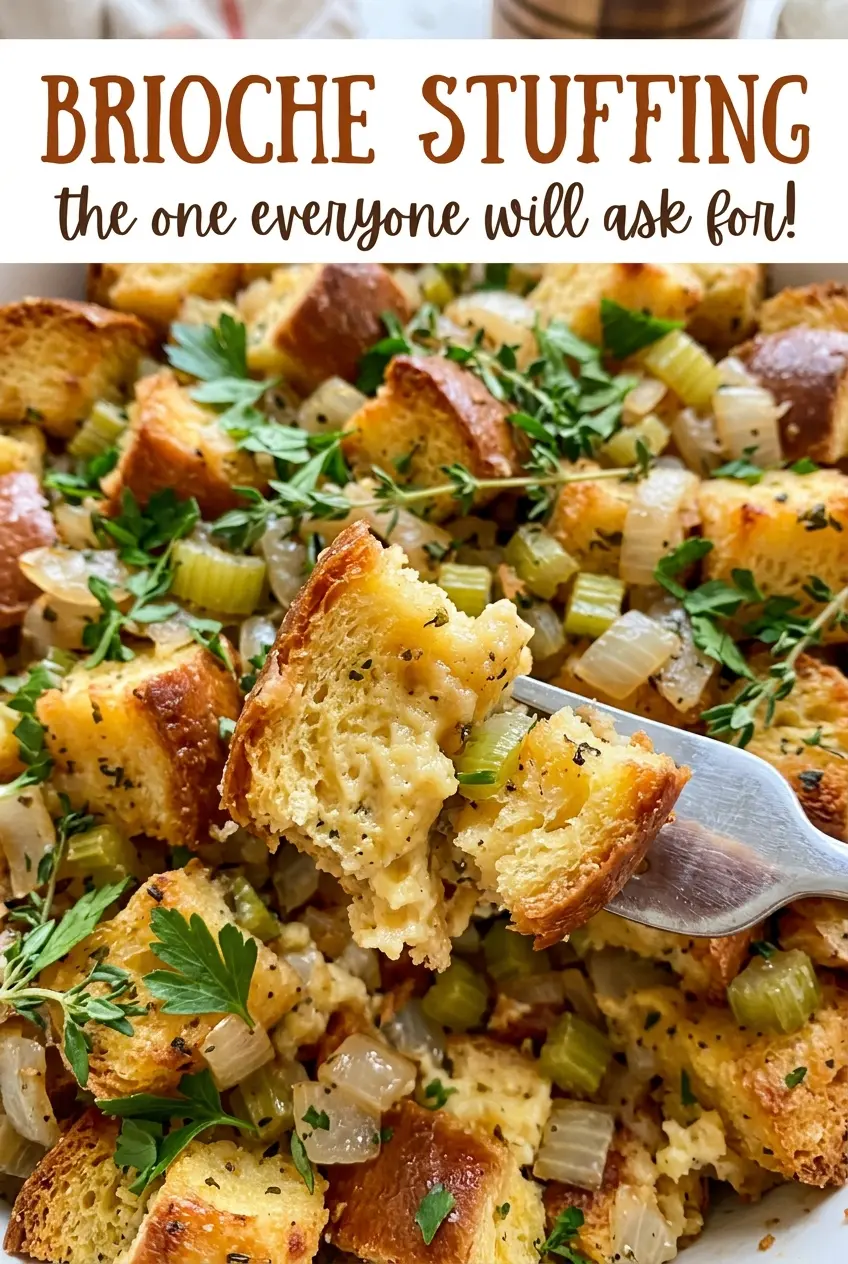
The onion softens in butter, and the sage turns fragrant in the skillet before the brioche even reaches the oven. That’s when this starts to feel like proper stuffing: buttery bread, tender vegetables, and herbs that smell warm without taking over. Brioche stuffing has a softer, richer crumb than a loaf of plain sandwich bread, so a little care with the first bake makes a big difference.
I dry the cubes slowly at a low temperature, then let them cool before adding the buttery vegetables and broth mixture. In the oven, foil keeps the center tender while the final uncovered stretch gives the top a deep golden finish. The contrast is what I want in every scoop: soft in the middle, with browned edges that still hold their shape.
Kitchen Note
Keep the brioche cubes close to 1 inch so they dry and soak evenly. Much smaller pieces can turn soft and compact, while oversized cubes leave you with dry corners beside a moist center.
Save this brioche stuffing for its tender center and golden, buttery top—an easy way to bring a little extra richness to the table.
Why Brioche Stuffing Needs a Covered Bake Before It Can Brown
Brioche brings plenty of richness on its own, but that soft crumb can lose its shape if the surface dries out before the center has time to set. Baking the dish covered first protects the moistened bread while the eggs and broth firm up into a cohesive stuffing. Taking the foil off too early gives the top a head start on browning, but can leave the middle lagging behind.
The two-part bake solves that timing problem without asking the bread to do two things at once. While the foil is on, the stuffing heats gently and stays moist. Once uncovered, the surface gets direct oven heat and turns golden while the center finishes cooking. I look for a browned top and a center that has reached at least 160°F, then give the dish a 10-minute rest so the scoops hold together better. That short pause also keeps the first serving from collapsing into a loose pile.
The Ingredients That Give Brioche Stuffing Its Rich, Savory Balance
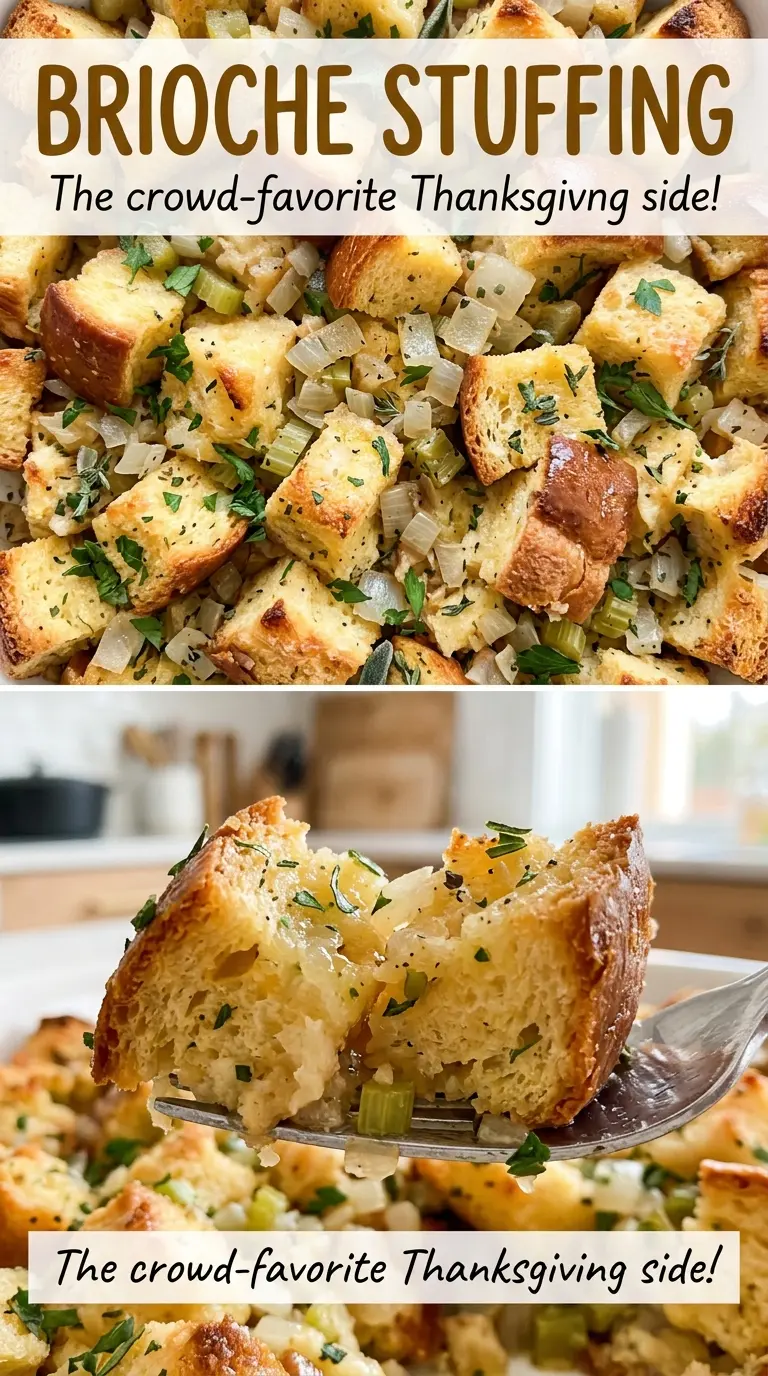
- Brioche — Its buttery crumb gives this stuffing a richer, softer center than ordinary white bread. Choose a loaf that’s fresh and intact rather than one already crumbling; the low oven dries it for the casserole. Challah is the closest swap: use a 1-pound loaf and cut it into the same-size cubes, knowing the result will be a little less buttery.
- Unsalted butter — It carries the onion, celery, and herbs and gives the top its satisfying richness. Unsalted butter also lets the kosher salt stay in control, especially with broth in the mix. Salted butter will work, but the finished stuffing may taste saltier.
- Onion and celery — These make the savory base and soften into the bread instead of competing with its tender texture. Chop them finely so they cook through in the skillet’s 8–10 minutes; large pieces stay noticeable in the finished casserole.
- Dried rubbed sage and dried thyme — Dried herbs infuse the butter quickly during their brief skillet cook. Rubbed sage has a softer, leafier texture than finely ground sage, so use the rubbed kind for the same even distribution. If you want a different herb note, the variation below gives a specific thyme swap.
- Low-sodium chicken broth and eggs — The broth moistens the dried bread, while the eggs help the mixture set instead of staying loose. Low-sodium broth leaves room for the measured salt and herbs to come through. The eggs are doing structural work here, so there isn’t a direct egg-free replacement that keeps the same set.
- Fresh flat-leaf parsley — Parsley adds a fresh, clean note that cuts through the butter. Flat-leaf leaves chop easily and distribute through the cubes; dried parsley won’t give the same fresh lift.
Dry the Brioche First, Then Build the Stuffing in Layers
Dry the Cubes Without Toasting Them Hard
Heat the oven to 300°F and spread the 1-inch brioche cubes over two rimmed baking sheets. Bake for 25–35 minutes, stirring once, until the cubes feel dry; the goal is to remove moisture, not to brown them deeply. Let them cool before you start combining the stuffing. Once they’re cool, increase the oven temperature to 350°F.
Soften the Vegetables in Herb Butter
Grease a 9×13-inch baking dish with 1 tablespoon of the butter. Melt the remaining 7 tablespoons in a 12-inch skillet over medium heat, then add the finely chopped onion and celery. Cook for 8–10 minutes, until both are tender rather than crisp. Stir in the sage, thyme, kosher salt, and black pepper, and cook for 1 minute so the herbs become fragrant without scorching.
Coat the Bread Before Adding the Egg Mixture
Put the cooled brioche in a large bowl and add the skillet mixture and chopped parsley. Toss until the butter and vegetables are distributed throughout the cubes; this first toss prevents all the savory bits from settling in one spot. In a separate medium bowl, whisk the chicken broth and eggs together. Pour the liquid over the bread and toss again, stopping when the cubes look evenly moistened rather than leaving broth pooled at the bottom.
Bake Covered, Then Uncover for the Golden Top
Transfer the mixture to the prepared dish and cover it with foil. Bake for 25 minutes, then remove the foil and bake for another 20–25 minutes, until the top is golden and the center is at least 160°F. If the center hasn’t reached that temperature, keep baking and check again rather than judging by color alone. Rest the stuffing for 10 minutes before serving.
How to Change the Bread or Broth Without Losing the Texture
Make It Gluten-Free with a Sturdy Loaf
Use a 1-pound gluten-free brioche or sturdy gluten-free bread, cut into 1-inch cubes, and follow the same drying and baking method. Gluten-free bread can absorb liquid differently, so toss thoroughly and look for even moisture across the cubes before transferring everything to the dish.
Use Vegetable Broth for a Vegetarian Dish
Replace the chicken broth with the same amount of low-sodium vegetable broth. The stuffing stays moist and savory, though it loses the deeper poultry note from chicken broth. Check that the brioche you choose is vegetarian, since some enriched breads contain ingredients that don’t fit every vegetarian diet.
Trade the Thyme for Crushed Rosemary
Replace the dried thyme with an equal amount of dried rosemary, crushed between your fingers before it goes into the skillet. Rosemary has a woodier, more pronounced aroma, so this version tastes bolder and a little less earthy than the sage-and-thyme combination.
Storage and Reheating
- Refrigerator: Store leftovers covered or in an airtight container for 3–4 days. The top softens in the refrigerator, while the center stays tender.
- Freezer: Freeze cooled portions in airtight containers for up to 2 months. Thaw overnight in the refrigerator for more even reheating.
- Reheating: Cover a baking dish with foil and warm at 325°F until the center reaches 165°F. Keep it covered so the brioche doesn’t dry out; uncover only briefly if you want to crisp the top again.
Questions That Come Up Before Brioche Stuffing Goes in the Oven
Brioche Stuffing
Ingredients
Equipment
Method
- Heat the oven to 300°F.
- Spread the brioche cubes over 2 rimmed baking sheets and bake for 25–35 minutes, stirring once, until dry.
- Let the brioche cubes cool, then increase the oven temperature to 350°F.
- Grease a 9x13-inch baking dish with 1 tablespoon of the butter.
- Melt the remaining 7 tablespoons butter in a 12-inch skillet over medium heat.
- Add the onion and celery, and cook for 8–10 minutes until tender.
- Stir in the sage, thyme, salt, and pepper and cook for 1 minute.
- Put the dried brioche in a large bowl, add the skillet mixture and parsley, and toss to combine.
- Whisk the chicken broth and eggs in a medium bowl.
- Pour the broth mixture over the brioche mixture and toss until evenly moistened.
- Transfer the mixture to the prepared baking dish.
- Cover the dish with foil and bake for 25 minutes.
- Uncover and bake for 20–25 minutes until golden on top and at least 160°F in the center.
- Rest for 10 minutes before serving.