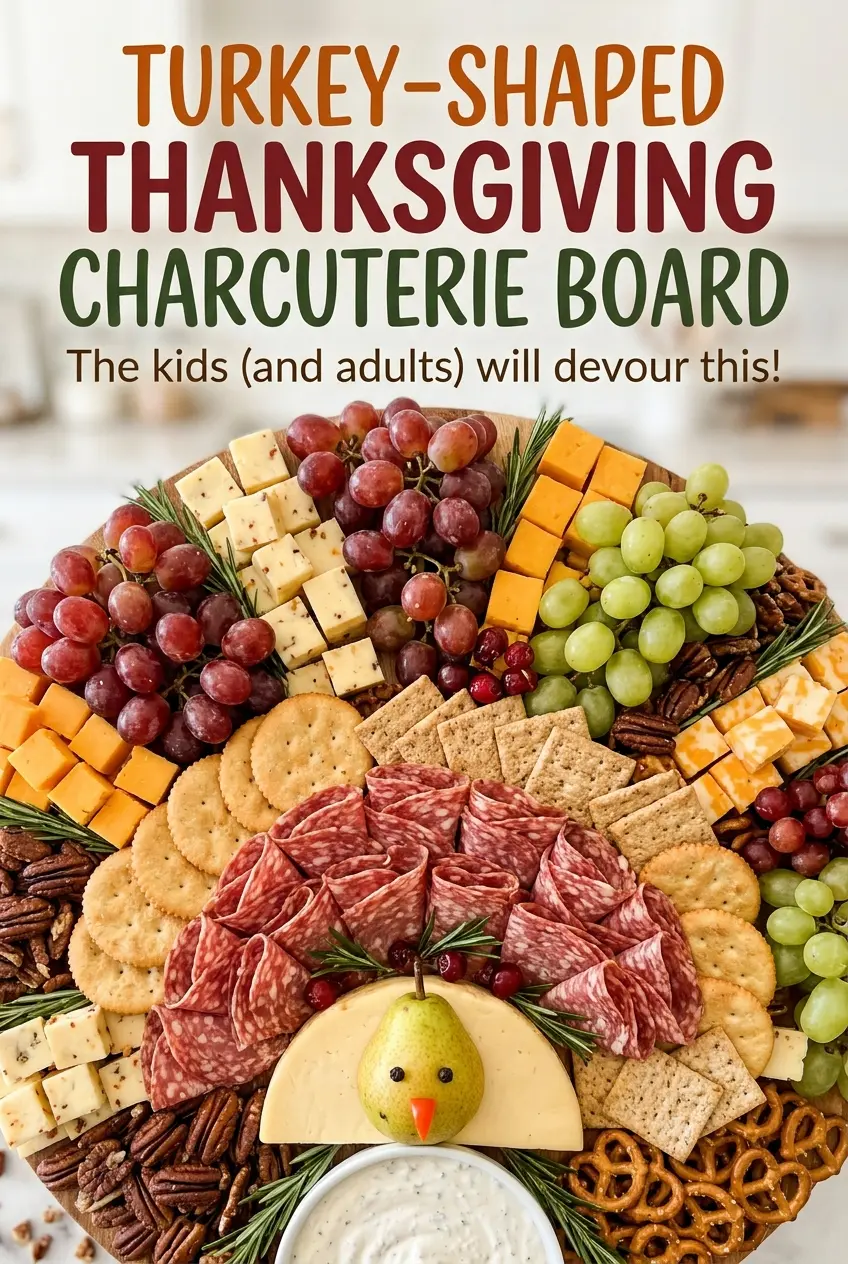
The folded turkey slices make a soft oval, but the board only starts to read as a turkey once the curved neck and little face are in place. I found that giving the body room near the lower center keeps the feather fan from swallowing the shape. On an 18×24-inch board, the deli turkey, salami, cheddar, crackers, fruit, and vegetables fit without needing to pile everything up.
I fold half the turkey slices for the body, then use the rest to make a curved neck and rounded head. The salami goes behind the turkey first, followed by the cheddar triangles and crackers in overlapping arcs. That order gives the feathers a clear outline, while the grapes, apricots, carrot sticks, pepper strips, and olives fill the open spaces. The finished board is colorful, easy to share, and made for grazing.
Kitchen Note
Cut the carrot beak small enough to sit neatly against the rounded head. The two thin pepper strips read as a wattle without covering the face.
Save this turkey-shaped Thanksgiving charcuterie board for a centerpiece with curved turkey slices, layered cheese-and-cracker feathers, and bright fruit accents.
Why the Feather Arcs Need to Start Behind the Turkey
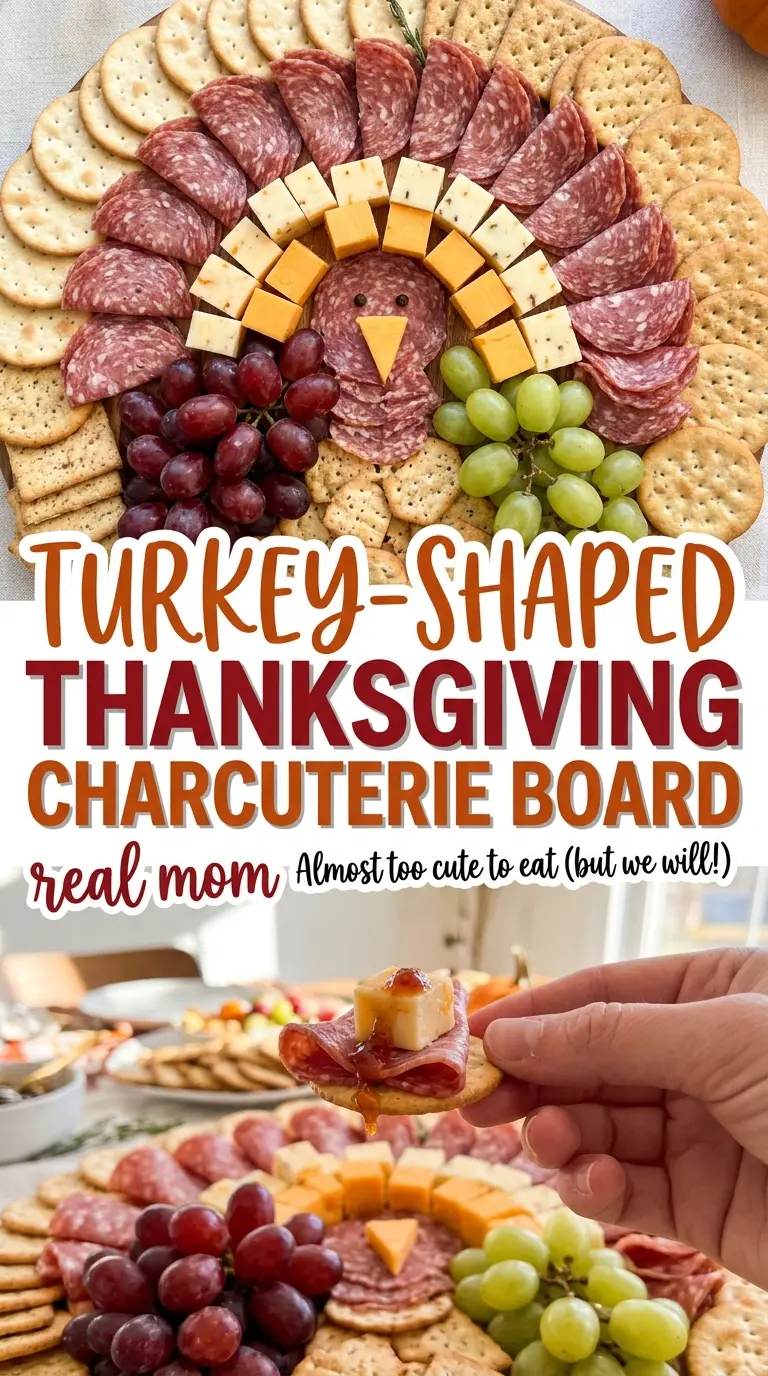
The shape stays recognizable when the turkey is the first thing your eye finds. That’s why I leave the lower center open for the folded body and build the feathers behind it, rather than spreading the ingredients around the entire board. The salami makes the first curved layer, and the cheddar and crackers extend that curve outward.
Overlapping arcs do more than make the board look full. They give each feather layer a visible edge, so the cheddar triangles don’t disappear against the salami and the crackers don’t read as a separate pile. Keep the arcs close enough to connect visually, but don’t press them into one flat band. The open spaces at the sides and bottom are useful: they’re where the grapes, apricots, olives, carrot sticks, and pepper strips can add color without crowding the turkey’s face. Think of the board as a clear silhouette with smaller accents around it, not a flat surface that needs to be covered from edge to edge.
How Each Ingredient Helps Build the Turkey
- Thinly sliced deli turkey — The thin slices fold into a smooth oval and curve into the neck more easily than thick slices. The pale, soft-edged body is part of what makes the turkey silhouette distinct; there isn’t a like-for-like swap among the other listed ingredients.
- Salami — Thinly sliced salami fans into the first semicircle of feathers. Thin slices are easier to curve into a continuous fan than thick pieces, and the darker color gives the following cheese and crackers a clear boundary.
- Cheddar — A block cut into thin triangles gives you a firm, recognizable feather shape. Cut the triangles thin so they can sit in an arc rather than looking like a row of heavy wedges. Another ingredient on this board won’t give the same yellow cheese layer.
- Assorted crackers — A mix gives the outer arc variation in shape and makes the board feel like a grazing platter, not just a meat-and-cheese display. A single kind of cracker works if that’s what you have, though the outer band will look more uniform.
- Carrot and red bell pepper — The carrot supplies both the small beak and the sticks that fill the board; the red pepper makes the thin wattle strips and adds more strips for the open spaces. Keep the beak piece small and cut the pepper strips thin so the face stays legible.
- Pitted green olives — One half makes the eye, while the rest become accents. Pitted olives are convenient here because you can halve one cleanly for the face without dealing with a pit on the board.
- Red and green grapes with dried apricots — The two grape colors add contrast, while the apricots bring a warm color and a different texture to the gaps between the feather arcs. Keep these as accents rather than building another large mound that competes with the turkey.
Shape the Turkey Before You Fan the Feathers
Fold the Body and Curve the Neck
Use an 18×24-inch board, then fold half the turkey slices into a 6-inch oval near the lower center. Arrange the remaining slices above it in a curved neck, finishing with a small rounded head. Keep the neck connected to the body so it reads as one shape, and leave enough room behind it for the semicircle of feathers.
Cut a small triangle from the carrot for the beak and cut the rest into sticks. Cut two thin strips from the red bell pepper for the wattle, then slice the remaining pepper into strips. Halve one olive and place one half for the eye; keep the other half with the remaining olives for the accents.
Layer the Semicircle
Fan the salami in a semicircle behind the turkey body. Arrange the cheddar triangles behind the salami, then add the crackers in overlapping arcs. If the layers look like one solid band, open up the curves enough to reveal the different ingredients; the distinct bands are what give the feathers their shape.
Fill the Gaps and Serve
Arrange the grapes, dried apricots, carrot sticks, bell pepper strips, and remaining olives in the open spaces. Use the smaller pieces to fill gaps without covering the turkey body or face. Take a moment to check that the eye, beak, and wattle are still visible from the serving side. Serve the board within 2 hours, or within 1 hour if the temperature is above 90°F.
Three Ways to Change the Board Without Losing Its Character
Make a meat-free grazing platter
Leave off the deli turkey and salami, then arrange the cheddar triangles and crackers as a broad fan with grapes, apricots, carrot, pepper, and olives in the gaps. It becomes a meat-free grazing platter rather than a full turkey silhouette, but keeps the same colors and shareable mix.
Let the cheddar and crackers form the feathers
Skip the salami and place the cheddar triangles and crackers directly in overlapping arcs behind the turkey. The feather fan will have fewer layers and a lighter look, while the turkey body remains the focal point.
Turn it into a smaller grazing arrangement
For a smaller spread, use fewer pieces of each ingredient and make a compact turkey with shorter arcs instead of trying to fit the full fan. The board will look less expansive, but the curved neck, rounded body, and small face can still carry the theme.
Serving, Holding, and Leftovers
- Serving window: Serve within 2 hours, or within 1 hour if the temperature is above 90°F.
- Leftovers: Refrigerate leftovers promptly. Store crackers apart from the fruit and other ingredients so they don’t soften.
- Freezer: Don’t freeze the assembled board; the crackers and fruit won’t keep their fresh texture after thawing.
Questions About Making the Turkey-Shaped Board
Turkey-Shaped Thanksgiving Charcuterie Board
Ingredients
Equipment
Method
- On an 18x24-inch board, fold half the turkey slices into a 6-inch oval near the lower center.
- Arrange the remaining turkey slices in a curved neck with a small rounded head at the top.
- Cut a small triangle from the carrot for the beak and cut the rest into sticks.
- Cut two thin strips from the bell pepper for the wattle and slice the rest into strips.
- Halve one olive, use one half for the eye, and reserve the other half with the remaining olives.
- Fan the salami in a semicircle behind the turkey body.
- Arrange the cheddar triangles and crackers in overlapping arcs behind the salami.
- Arrange the grapes, apricots, carrot sticks, bell pepper strips, and remaining olives in the open spaces on the board.
- Serve within 2 hours, or within 1 hour if the temperature is above 90°F.
- Refrigerate leftovers promptly.