
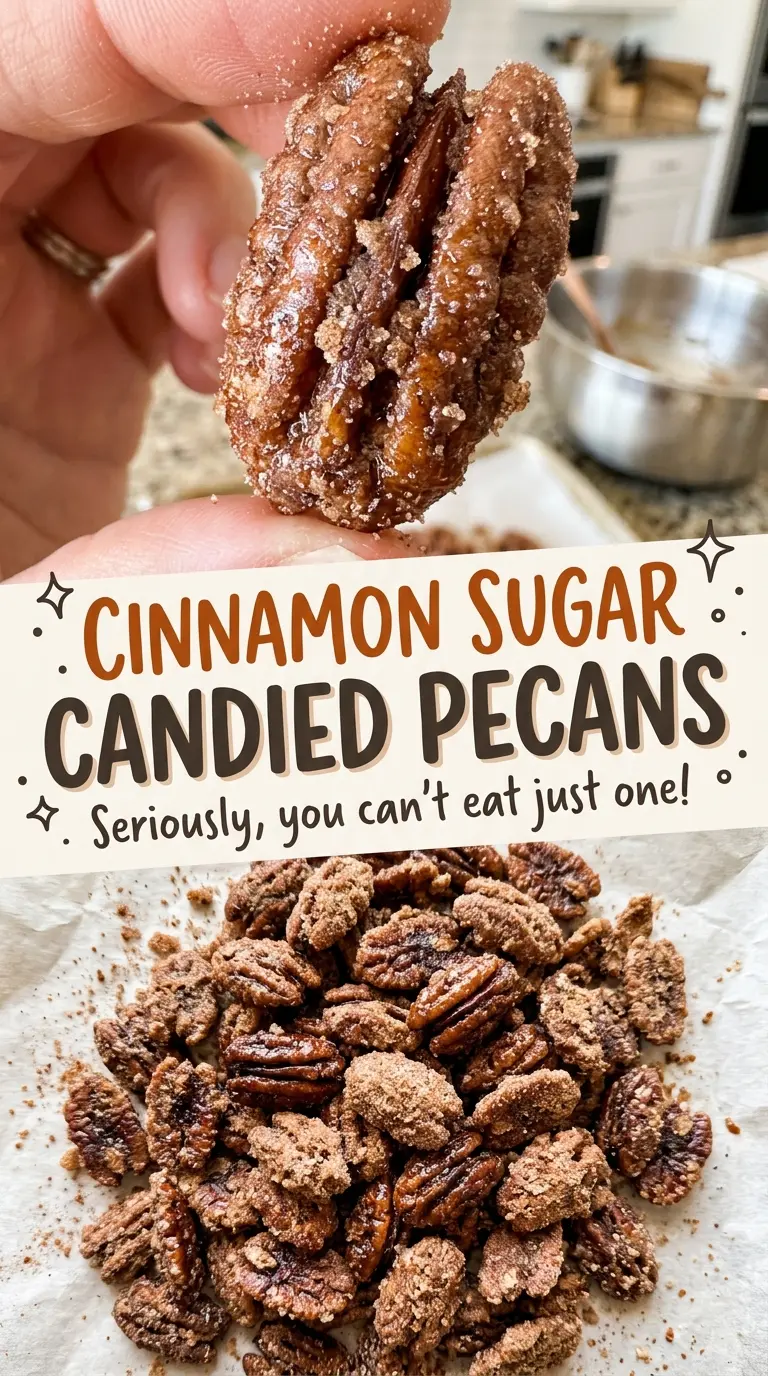
When the pecans first go into the oven, they look glossy and wet, not like the crisp snack you’re waiting for. That’s normal. The coating needs time to dry, and these Cinnamon Sugar Candied Pecans turn fragrant as the sugar and cinnamon settle into an even layer around each half.
I whisk the egg white with water and vanilla until foamy, then toss the pecans until every surface is lightly coated. The sugar mixture goes on after that, which helps it cling instead of sinking into a wet patch at the bottom of the bowl. A low oven and regular stirring do the rest without rushing the coating.
Give the pecans room on the baking sheet and let them cool all the way before you taste for crunch. You’ll have sweet, cinnamon-scented halves with a dry coating that’s easy to snack on or crush into a topping.

Kitchen Note
The coating can feel a little soft while the pecans are hot, so don’t judge the crunch straight from the oven. Let the nuts cool completely on the pan; the coating firms as they cool.
Save these Cinnamon Sugar Candied Pecans for a crisp, cinnamon-coated snack that’s easy to make ahead.
Why These Pecans Dry Crisp Instead of Turning Into Sticky Clumps
Candied pecans don’t need a bubbling caramel to get a crisp shell. Here, the egg white helps the sugar mixture cling to the nuts, and the oven dries that coating gradually. At 250°F, the pecans have time to lose the moisture from the egg-white mixture while the sugar and cinnamon stay on the surface. A hotter oven would move the process along faster, but it would also leave less room to dry the coating evenly before the outside gets too dark.
The even layer matters just as much as the oven temperature. When pecans overlap, the covered spots hold moisture and the coating can stay tacky there. Stirring every 15 minutes moves the nuts around the pan, so the exposed sides change places and the coating dries more consistently. Keep the pecans spread out again after each stir rather than leaving a mound in the middle.
There’s no need to chase a deep brown color. The useful finish cues are a dry coating and a fragrant cinnamon smell. The pecans may still feel tender when they’re hot; their final crunch develops as they cool, so color alone isn’t a dependable test.
What the Egg White, Pecans, and Cinnamon Each Bring
- Pecan halves — Halves give you substantial bites and broad surfaces for the cinnamon-sugar coating to cling to. Choose pecans that smell fresh and nutty; stale pecans can taste flat beneath the sweet coating. Keeping the halves intact also makes the pieces easier to stir without breaking them up.
- Egg white — This is the binder that helps the sugar mixture stay on the pecans. The yolk isn’t used here; its fat would change the coating. Whisk the white with the water and vanilla until foamy before adding the nuts.
- Granulated sugar — The fine crystals spread readily over the coated pecans and dry into the crisp, sweet shell. There’s no need for specialty sugar; regular granulated sugar is the right choice for an even coating.
- Ground cinnamon — Cinnamon gives the pecans their warm aroma and defining flavor. Fresh-smelling ground cinnamon makes the biggest difference here; if yours has been open a long time and smells faint, the finished nuts will taste less fragrant.
- Vanilla extract — Vanilla rounds out the cinnamon and sugar with a softer aroma. Use an extract you like the smell of straight from the bottle; the amount is small, but it’s noticeable in the finished coating.
- Kosher salt — Salt keeps the sugar from tasting one-note and helps the pecan flavor come through. Kosher salt is the type used here; finer table salt doesn’t measure the same by volume, so stick with kosher salt for this ingredient list.
How to Coat and Dry the Pecans Without Bare Spots
Foam the Egg White Before Adding the Nuts
Heat the oven to 250°F and line a rimmed 13×18-inch baking sheet with parchment paper. In a large bowl, whisk the egg white, water, and vanilla until foamy. You’re looking for bubbles across the surface, not a stiff meringue. If the mixture is still clear and liquid, keep whisking before the pecans go in.
Coat the Pecans in Two Passes
Add the pecan halves to the foamy egg-white mixture and toss until the surfaces are covered. In a separate small bowl, stir together the sugar, cinnamon, and kosher salt, then add that mixture to the pecans. Toss again until the cinnamon sugar is distributed across the nuts instead of sitting in a pile at the bottom. Keep turning the pecans through the mixture so you don’t end up with a few heavily coated pieces and several bare ones.
Spread Them Out and Stir on Schedule
Transfer the coated pecans to the prepared baking sheet and spread them into an even layer. Bake for 60 to 75 minutes, stirring every 15 minutes. After each stir, spread the nuts back out so they aren’t stacked or crowded in one area. The coating should be dry, and the pecans should smell fragrant when they’re ready to come out.
Let the Coating Set on the Pan
Take the baking sheet out of the oven and leave the pecans right on the parchment to cool completely. Don’t move them to a bowl while they’re warm, when the coating is still settling. Once cool, separate any pieces that have stuck together. The finished pecans should feel dry rather than tacky.
Two Ways to Change the Texture Without Changing the Cinnamon-Sugar Base
Make a coarse pecan crunch
After the pecans are fully cool, chop some into small pieces with a knife. You’ll get a mix of larger bites and crunchy bits, which makes the batch easier to sprinkle over another food or portion into smaller snacks. Chop only once the coating has set so the sugar doesn’t smear across the cutting board.
Turn a portion into a fine pecan crumb
For a finer finish, pulse a portion of the cooled pecans briefly in a food processor. Stop while the pieces still look like crumbs; pecans release oil if they’re processed too long, and the crumb can turn pasty. This changes the texture while keeping the cinnamon-sugar coating intact.
Keep the batch gluten-free and dairy-free
The ingredients in this version include no wheat or dairy, so no swap is needed for a gluten-free or dairy-free batch. The egg white remains part of the coating, which means this isn’t a vegan adaptation. The result stays the same crisp, cinnamon-sugar pecan.
Storage and Reheating
- Refrigerator: Store fully cooled pecans in an airtight container for up to 2 weeks. Cold storage can soften the coating slightly; let the sealed container come to room temperature before opening to limit condensation.
- Freezer: Freeze in an airtight container for up to 2 months. Thaw the container while closed so moisture doesn’t collect directly on the pecans.
- Reheating: These are best eaten at room temperature and don’t need reheating. Skip the microwave, which can melt the sugar unevenly and leave some pieces sticky.
Questions That Come Up When Making Candied Pecans
Cinnamon Sugar Candied Pecans
Ingredients
Equipment
Method
- Heat the oven to 250°F.
- Line a rimmed 13x18-inch baking sheet with parchment paper.
- In a large bowl, whisk the egg white, water, and vanilla until foamy.
- Add the pecans and toss to coat.
- In a small bowl, stir together the sugar, cinnamon, and salt.
- Add the sugar mixture to the pecans and toss until evenly coated.
- Spread the pecans in an even layer on the prepared baking sheet.
- Bake for 60 to 75 minutes, stirring every 15 minutes, until the coating is dry and the pecans smell fragrant.
- Cool completely on the baking sheet.
- Separate any pieces that stick together.